

Introduction
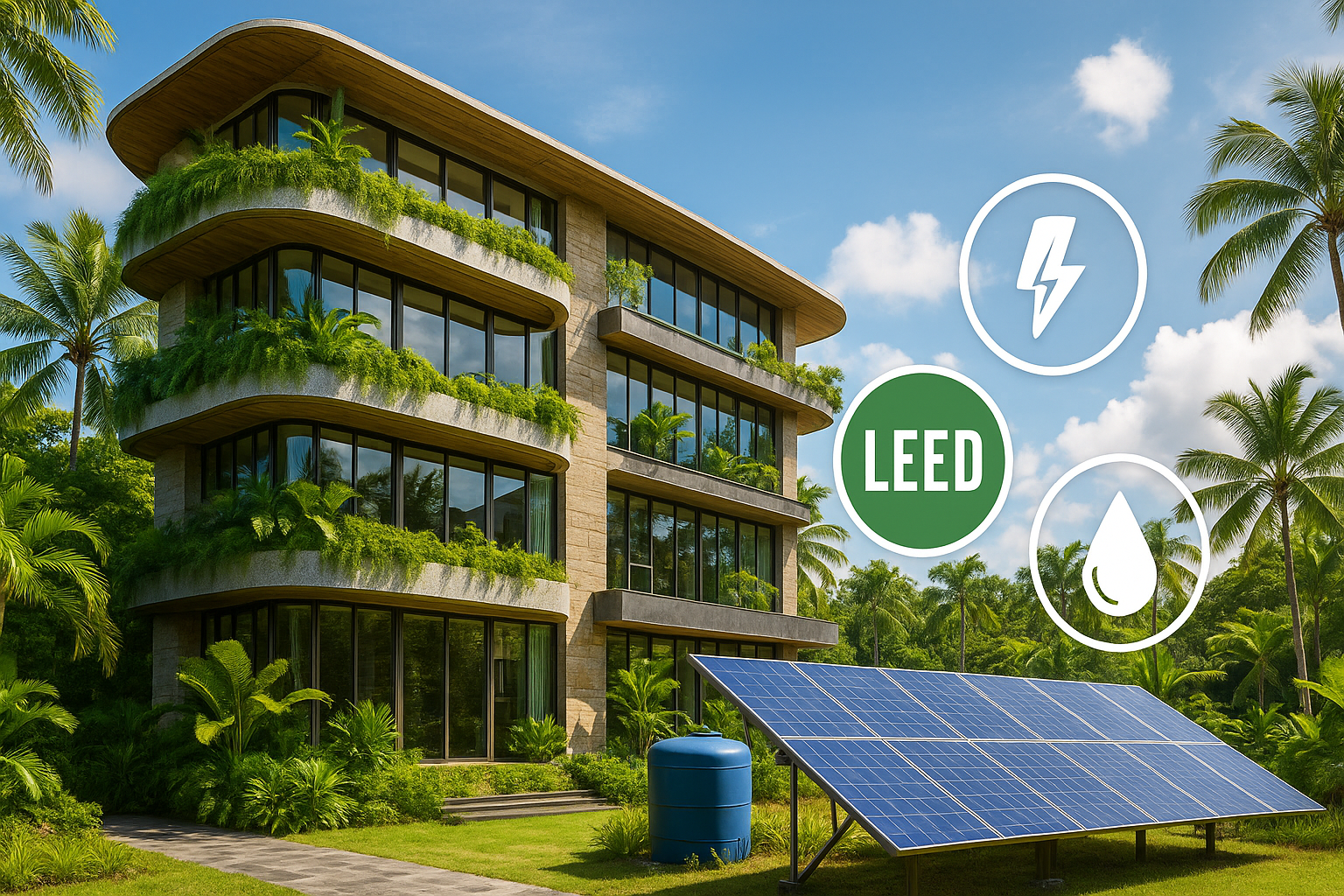
At Elixir Planning and Monitoring Development Company, our Research and Development Unit focuses on sustainable building design and LEED certification strategies customized for tropical climates. By optimizing energy consumption, reducing greenhouse gas emissions, and implementing innovative waste and water reduction solutions, we help clients design and retrofit buildings that meet the highest international standards of environmental performance.
Optimizing Energy Consumption in Tropical Climates
Energy use in tropical buildings is primarily driven by cooling needs. Through passive design strategies—including advanced glazing, natural ventilation, shading devices, reflective roofing, and phase-change materials—our team achieves significant reductions in operational energy demand.
Simulation-based green design following LEED energy performance guidelines has shown up to 23% energy savings compared to conventional baselines. Retrofitting projects that combine passive and active measures, such as upgrading appliances and improving insulation, can achieve even higher efficiency.
Additionally, photovoltaic (PV) systems demonstrate excellent performance in tropical regions, offering economically viable net-zero energy targets thanks to high solar efficiency.
Reducing Greenhouse Gas Emissions
At Elixir, our approach to carbon reduction integrates renewable energy systems, bio-based materials, and smart building technologies. LEED-aligned designs can achieve up to 65% total carbon reduction, particularly when incorporating building-integrated photovoltaics and radiant cooling systems.
Using timber and bio-based construction materials can reduce embodied carbon emissions by as much as 73%, reinforcing our commitment to sustainable material sourcing. While LEED currently focuses more on operational emissions, Elixir advocates for greater recognition of embodied carbon in green building certification frameworks.
Water and Waste Reduction Strategies
Water efficiency is critical in tropical urban regions where water scarcity and high humidity coexist. Our LEED-compliant strategies include:
-
High-efficiency plumbing fixtures and dual-flush systems
-
Native landscaping and green roofs
-
Rainwater harvesting and greywater recycling
-
Integrated energy-water management systems (e.g., condensate recovery for cooling towers)
These methods can reduce total water use by up to 73%, minimize waste generation, and support circular resource management throughout a building’s life cycle.
Regional Adaptation and Implementation
Although LEED standards were developed primarily for temperate regions, Elixir’s R&D team tailors these frameworks for tropical environmental conditions. By integrating localized building codes, regional incentives, and cost-effective energy efficiency strategies, we ensure LEED certification remains practical and impactful across diverse tropical settings.
Continuous monitoring and performance validation ensure that predicted energy and water savings are realized, contributing to long-term sustainability and resilience.
Key LEED Strategies and Their Impacts in Tropical Regions
| Strategy / Outcome | Typical Impact | References |
|---|---|---|
| Passive cooling & insulation | 23–36% energy savings | Thebuwena & Rathnayake (2022); Nematchoua et al. (2021) |
| On-site photovoltaics | 48–66% GHG reduction (life cycle) | Satola et al. (2020); Mulya et al. (2024) |
| Efficient water fixtures & reuse | Up to 73% water savings | Thebuwena et al. (2024); Romano et al. (2023) |
| Bio-based materials | Up to 73% embodied GHG reduction | Amiri et al. (2021) |
| Green roofs / landscaping | 84% heat transfer reduction | Kachenchart & Panprayun (2024) |
| Integrated retrofitting | Lower costs, faster payback | Nematchoua et al. (2021); Benitez et al. (2022) |
Conclusion
Achieving LEED certification in tropical regions requires a holistic approach that integrates energy optimization, carbon reduction, water efficiency, and sustainable materials. Through research-driven design, Elixir Planning and Monitoring Development Company delivers eco-friendly, cost-effective, and high-performance building solutions that contribute to global sustainability goals and climate resilience.